

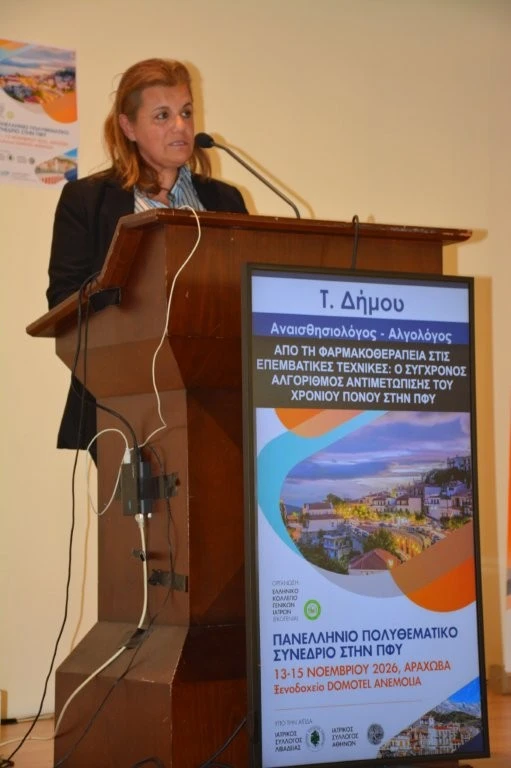
On 13–15 November 2026, the Panhellenic Multidisciplinary Conference on Primary Health Care took place in Arachova, Greece, organised by the Hellenic College of General Practitioners (EKOGENIA). Dr Triantafyllia Dimou, Anaesthesiologist and Pain Specialist, spoke to family doctors on “From medication to interventional techniques: the modern algorithm for treating chronic pain”.
Her message was simple: chronic pain should not be treated with the same prescription over and over again. It needs the right diagnosis of the type of pain, a step-by-step plan and timely referral when medicines are not enough. Below are the key points of the talk, written for you.
What is chronic pain
Pain is called chronic when it lasts more than 3 months, or continues after the tissue should already have healed. It is called refractory when it does not improve significantly despite appropriate treatments having been tried.
It is not rare: in Europe it affects roughly one in five adults and is one of the most common reasons people see their family doctor. And it is not only the body that hurts: it affects work, walking, sleep, mood and a family’s finances.
Not all pain is the same
The first key is to know what kind of pain it is, because that decides what will help:
- Pain from inflammation or tissue damage, as in knee osteoarthritis.
- Neuropathic pain, when the nerve itself is affected: trigeminal neuralgia, pain after shingles, diabetic neuropathy. It is often described as burning, electric shocks or numbness.
- Mixed pain, with features of both, as often in low back pain with sciatica.
- Central pain and sensitisation syndromes, such as fibromyalgia, where the nervous system “amplifies” the pain signal.
For example, an anti-inflammatory may help pain from inflammation, but is usually not enough for nerve pain.
The first step: a careful assessment
Before any treatment, the doctor needs to understand your pain: where it is, what it feels like, what makes it worse and what you have already tried. Simple questionnaires are used too, such as the 0–10 pain scale and specific questionnaires for nerve pain or fibromyalgia. Sleep, mental wellbeing, mobility and the medicines you already take are also assessed.
Warning signs matter most. If the pain comes with any of the following, it needs prompt investigation, not waiting:
- unexplained weight loss or fever
- a history of cancer
- pain that wakes you at night
- weakness or numbness that is getting worse
The foundation at every stage: not just medicines
Chronic pain and poor sleep, anxiety, depression and fear of movement all feed into each other. That is why, at every stage of treatment, the foundation is targeted physiotherapy and graded exercise and, where needed, psychological support such as cognitive behavioural therapy.
A realistic goal matters too. In chronic pain it is not always possible to make the pain disappear completely. But it is possible to improve daily life substantially: to walk, work and sleep.
Medicines: matched to the type of pain
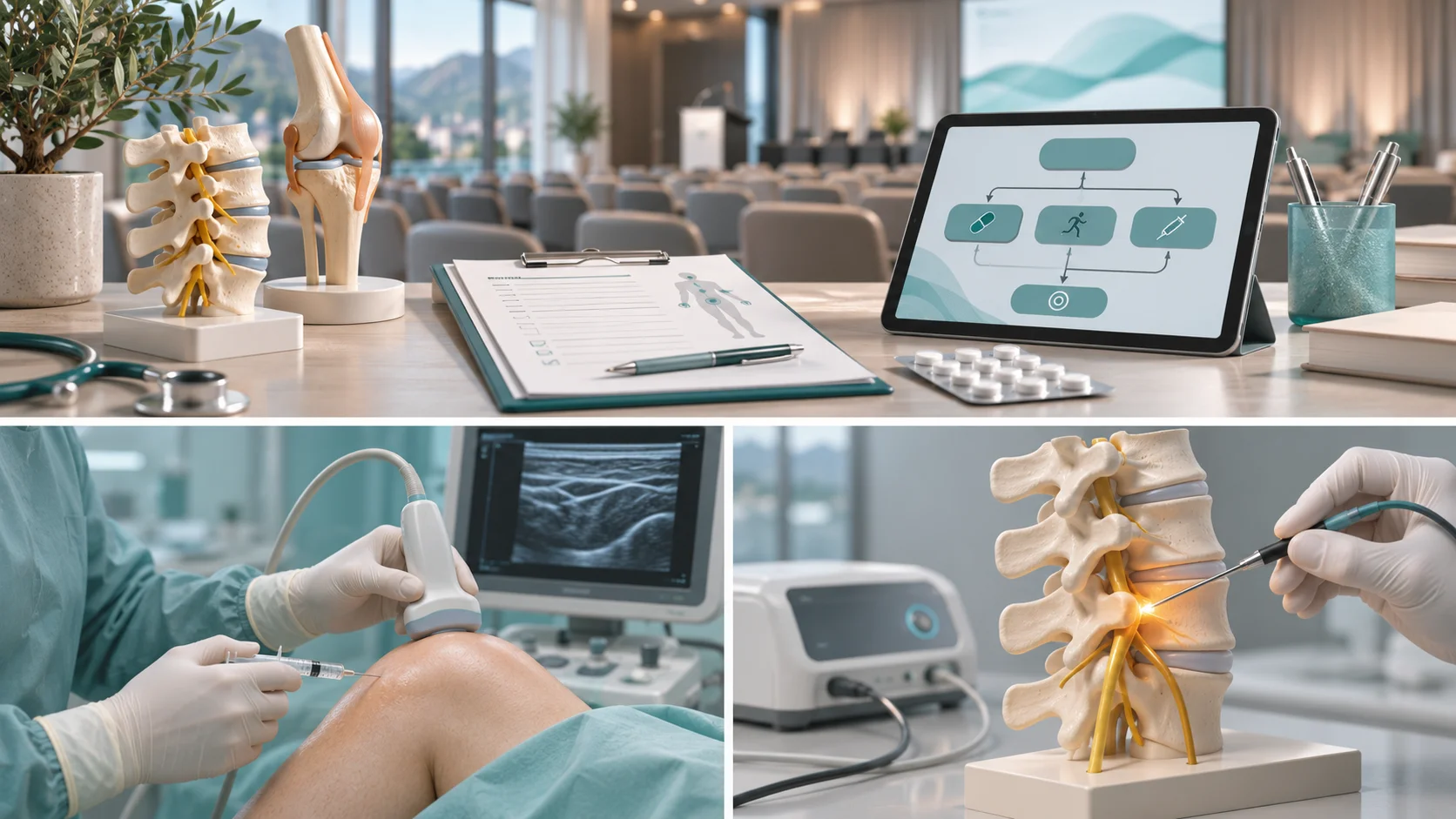
There is no single medicine for everyone. The choice is made by the doctor, based on what is causing the pain. The talk highlighted a few key points:
- Anti-inflammatories: help pain from inflammation, but carry risks for the stomach, kidneys and blood pressure. They are given at the lowest effective dose for a short time, not “indefinitely” without review.
- Paracetamol: widely used, but in chronic pain its effect is often limited. Take care with the dose and with combination products that already contain it, because in overdose it damages the liver.
- Medicines for nerve pain: certain antidepressants and anti-epileptic medicines are not given here for depression or epilepsy, but because they regulate the pain signal in the nerves. They need the right dose and monitoring, as they can cause dizziness, drowsiness or weight gain.
- Topical patches: for localised nerve pain, such as after shingles, special patches act locally with fewer effects on the rest of the body. They are particularly useful in older people.
- Opioids: are not a first-line treatment for chronic pain not caused by cancer, because of the risk of dependence and serious side effects. They are considered only in selected cases, with clear goals and regular review.
Do not start, change or stop medicines on your own. This matters especially if you already take several medicines, because combining some pain medicines with sedatives or sleeping tablets can be dangerous.
When it is time for a pain clinic
The talk presented clear criteria for when medicines are not enough. It is worth discussing a referral to a pain clinic with your doctor when:
- the pain stays at 5/10 or higher despite appropriate treatment for 6–12 weeks
- the medicines cause side effects you cannot tolerate (drowsiness, dizziness, stomach problems) or you take many medicines together
- the pain stops you from working, sleeping or doing physiotherapy
The pathway Dr Dimou proposed has three stages:
- Family doctor: rules out warning signs, identifies the type of pain and starts education, physiotherapy and targeted medication.
- Review at 6–12 weeks: if there is not enough improvement, the dose or the class of medicine is changed.
- Timely referral to a pain clinic: where minimally invasive techniques are considered, as a normal part of treatment and not as a “last resort”.
Minimally invasive techniques
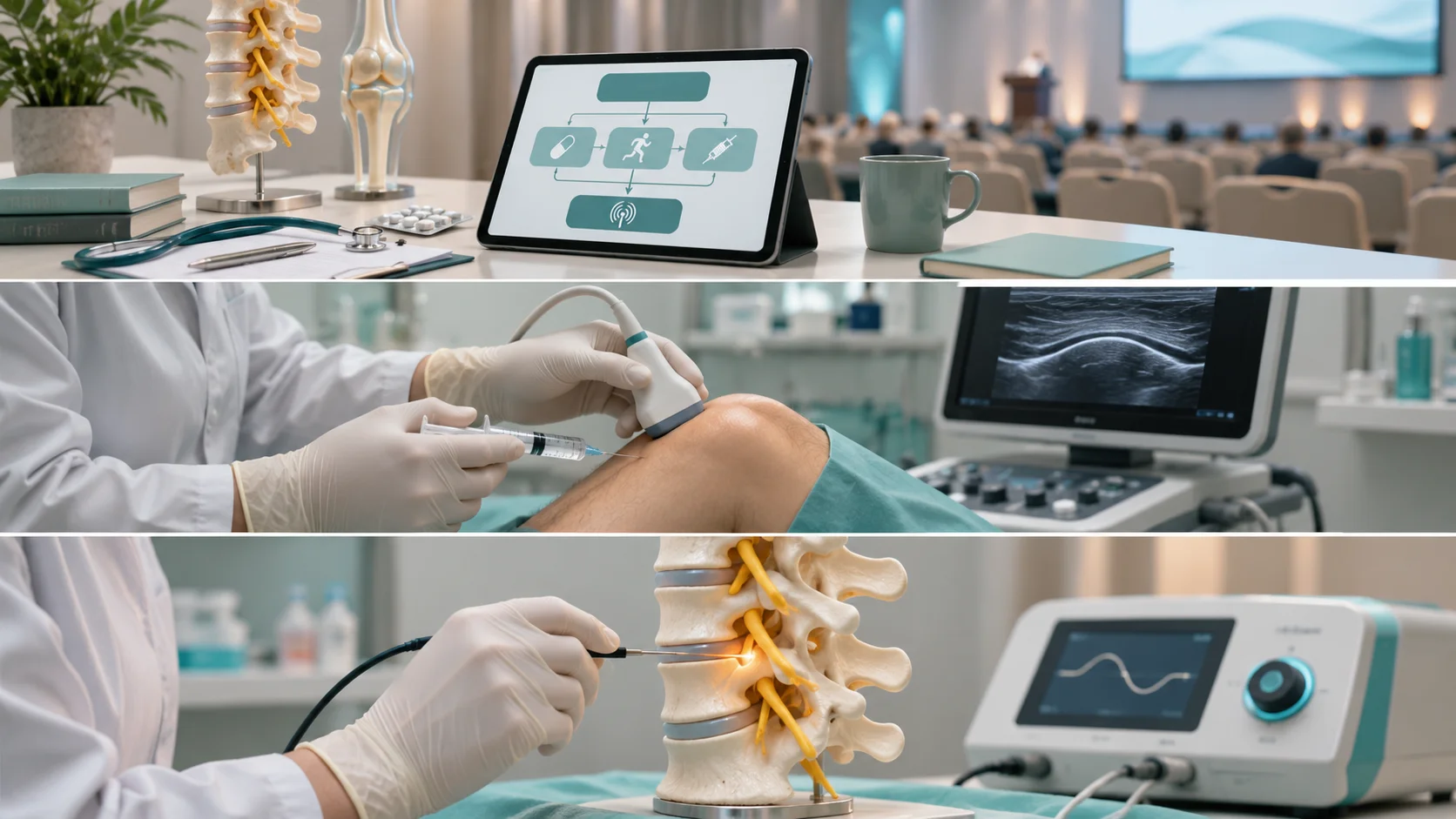
These techniques are performed under continuous ultrasound or X-ray guidance, so that the medicine or needle reaches exactly the right spot. They are done without general anaesthesia and without a hospital stay, and patients return quickly to their activities. They often have a dual role: they confirm exactly where the pain comes from and treat it at the same time.
Nerve blocks
Local anaesthetic, often with a corticosteroid, placed near the nerve that hurts:
- Epidural or transforaminal injection, for pain travelling down the leg from a herniated disc or spinal stenosis. See also our article on sciatica.
- Medial branch block, the most reliable test to show whether back or neck pain comes from the small joints of the spine.
- Peripheral nerve blocks, for nerves such as those of the head, shoulder, chest or thigh, under ultrasound.
Radiofrequency and cryoneurolysis
A thin electrode or probe “calms” the nerve that carries the pain, using heat or cold:
- Thermal radiofrequency (80°C): switches off the small branches that send pain from the spinal joints, the sacroiliac joint, or the knee and hip with osteoarthritis.
- Pulsed radiofrequency (42°C): does not destroy the nerve, but changes the way it transmits pain. Suitable for nerve root pain and nerve pain.
- Cryoneurolysis (-60°C to -80°C): uses very low temperatures to temporarily “freeze” specific sensory nerves, interrupting the transmission of the pain signal to the brain.
In carefully selected patients, relief from thermal radiofrequency can last 6 to 18 months. This window allows the patient to strengthen their muscles with exercise. More on our radiofrequency treatment page.
Implantable systems
For pain that does not improve with any of the above:
- Spinal cord stimulation: thin electrodes send gentle electrical signals that “mask” the pain, for example after failed spinal surgery or in diabetic neuropathy.
- Dorsal root ganglion stimulation: more targeted, for pain in a specific area such as the foot or groin.
- Intrathecal pumps: deliver medicine directly near the spinal cord in a very small dose, for refractory cancer pain or severe spasticity.
Two examples from everyday practice
Dr Dimou showed how this pathway works with two typical examples:
- A 68-year-old patient with knee osteoarthritis. Simple painkillers are not enough and anti-inflammatories are not safe because of high blood pressure and sensitive kidneys. The solution was radiofrequency to the nerves of the knee, under ultrasound guidance.
- A 48-year-old patient with low back pain and sciatica. Leg pain of 8/10 after 8 weeks of medication. A transforaminal epidural injection gave rapid relief.
The central idea is the “window of opportunity”. The procedure reduces pain enough for the patient to do physiotherapy and exercise. This lowers the risk of the pain becoming chronic.
Family doctor and pain clinic, together
The talk closed with a model of collaboration. The family doctor recognises the problem early and refers. The pain clinic intervenes in a targeted way. Afterwards, the family doctor takes over again and, where possible, gradually reduces medication.
At the Therapia Specialists Pain Care Unit, in Glyfada and Chalandri, Athens, we follow exactly this approach. Care starts with a careful assessment, and Dr Triantafyllia Dimou discusses with you the options that suit your case, in consultation with the doctor who follows you. For low back pain, see also 6 ways of treating chronic low back pain without surgery.
Chronic pain is not something you simply have to get used to. Book an assessment in Glyfada or Chalandri.
Sources
- Dimou T. From medication to interventional techniques: the modern algorithm for treating chronic pain. Panhellenic Multidisciplinary Conference on Primary Health Care, EKOGENIA, Arachova, 13–15 November 2026.
- Breivik H, Collett B, Ventafridda V, Cohen R, Gallacher D. Survey of chronic pain in Europe: prevalence, impact on daily life, and treatment. Eur J Pain, 2006;10(4):287–333.
- Treede RD, Rief W, Barke A, et al. Chronic pain as a symptom or a disease: the IASP Classification of Chronic Pain for the ICD-11. Pain, 2019;160(1):19–27.
This article is for information only and does not replace a medical examination.